
Author: Albert Ninyeh

  • The 5 Pride Sounds Every Young Minister Must Avoid.

    The 5 Pride Sounds Every Young Minister Must Avoid.

    The most perfect creation of heaven was Lucifer, the light bearer, the morning star, the embodiment of beauty, excellence, and sound. Yet it was this very perfection that became the womb of his downfall.

    We learn from him that beauty without humility is corruption in disguise.
    Lucifer didn’t fall because of weakness, he fell because of self-importance.

    In Isaiah 14:13–14, we hear the five dangerous sounds of pride :: what I call

    *The I-Wills of Lucifer*

    Every young minister, worship leader, or musician must be alert to these sounds in their own heart.

    If the most anointed and gifted angel could fall, then you and I must stay humble, watchful, and broken before God.
    For the sake of your life, your ministry, and the efficacy of the presence of God upon your assignment, avoid these five sounds.

    1. I Will Ascend into Heaven :: The Sound of Self-Exaltation

    This is the voice that says, “I must be seen. I must be noticed. I must be on the main stage.
    It’s the desire to rise without permission, to elevate yourself above process or authority.

    Many young ministers today want to be known before they are grown.
    They want platforms, not purity. Recognition, not refinement.

    2. I Will Exalt My Throne Above the Stars of God :: The Sound of Competition

    This is the spirit that compares and competes.
    It says, I can sing better than him.
    Why was she chosen and not me?”
    They don’t know my worth.”

    Comparison births pride, and pride breeds rebellion.

    3.I Will Sit on the Mount of the Congregation :: The Sound of Control

    This is the spirit that wants influence without submission.
    Lucifer wanted to sit where God sits, to control what God leads.
    In today’s language, it’s the worship leader who doesn’t want to be corrected, the musician who feels too anointed to be directed.

    4. I Will Ascend Above the Heights of the Clouds :: The Sound of Superiority

    This is the pride that hides in spiritual success.
    It says, “I’m too anointed to be told what to do.

    No one can teach me anymore.

    It’s subtle, because the person appears spiritual, but deep inside, they’ve stopped learning.

    5. I Will Be Like the Most High” — The Sound of Self-Deification

    This is the final and most dangerous sound.
    It’s when a minister begins to secretly crave the honor that belongs to God.
    They enjoy the attention, the applause, the admiration, and slowly, the altar becomes a stage.
    This is how the anointing becomes entertainment.

    Stay Low to Stay Anointed
    Be Watchful .

  • 10 Ways To Overcome Entitlement That Destroys Young Ministers.

    10 Ways To Overcome Entitlement That Destroys Young Ministers.

    Many young ministers, musicians, and church workers start well… but somewhere along the journey, entitlement creeps in.
    We begin to feel “The church owes me, or “My pastor should have rewarded me by now.

    Truth is, everyone who serves deserves honor, but when entitlement replaces gratitude, we stop growing and start dying inside.
    Let’s fix that.👇🏽

    1. Remember Who You’re Serving.
    You’re not serving for the church, you’re serving through the church.
    Your reward is with God, not men. Col. 3:24

    2. Kill the “I Deserve” Mentality.
    You don’t de-serve, you-serve.
    Every act of service is a privilege, not a right.
    Gratitude keeps your heart pure.

    3. Don’t Compare Your Journey.
    What God gives to one person isn’t the same for another. Comparison breeds discontentment.
    Stay in your lane, and your reward will find you.

    4. Guard Against the Trap of Expectations.
    It’s okay to hope, but dangerous to expect rewards from men. Serve freely, not as an employee, but as a steward.

    5. Beware of Greed.
    The moment your eyes shift from God to what’s in your leader’s hands, you lose focus.
    That’s how Gehazi fell.
    Don’t chase the gold, chase the grace.

    6. Stay Grateful, Even When Overlooked.
    You’re not forgotten; you’re being prepared.
    God keeps records better than any church secretary.

    7. Keep Learning and Growing.
    Don’t just serve, develop.
    Learn the systems, the Word, and excellence, Do something for yourself. God rewards skill, not complaint.

    8. Celebrate Others’ Rewards.
    If someone else gets what you were praying for, clap for them genuinely. Your attitude determines your altitude.

    9. Keep the Heart of a Son, Not a Hireling.
    Sons serve with love.
    Hirelings serve for pay.
    God always promotes sons.

    10. Focus on the Anointing, Not the Allowance
    The old generation sought the anointing, today many seek the allowance.
    Be among the few who still value oil over honorarium.

    If you ever feel unappreciated, pause and whisper: Lord, thank You for trusting me enough to serve. Your unseen service is building unseen greatness.Don’t let entitlement kill what obedience is still growing.


    By Yaa Ayeh

  • “God Told Me To Start” But My Pastor Said Wait: Who Do I Obey As a Young Minister?

    “God Told Me To Start” But My Pastor Said Wait: Who Do I Obey As a Young Minister?

    This question keeps troubling many young ministers, worshippers and musicians:
    Should I obey God and disobey my pastor?

    Recently, a minstrel told me God instructed him to start a worship ministry. When he informed his pastor, the response was simple: WAIT.
    Instead of waiting, he wanted to move immediately “to obey God.”

    This is where many sincere people get it wrong sincerely.

    Many people have obeyed God’s instruction and still failed – not because God was wrong, but because they moved without the release of spiritual authority.

    God works with order and systems, He will not build destiny through rebellion.

    Jesus could have been born without Joseph, but God still went to convince Joseph before the prophecy was fulfilled.

    Why?
    Because God does not fulfill destiny through disorder.

    If God truly sent you, He is also powerful enough to touch the hearts of the leaders over your life.
    The assignment is from God and so is timing too. Most times, God uses spiritual authority to manage both.

    Moving fast without covering may look spiritual – but it is dangerous.

    So i said to him, if your assignment is time- bound do this:

    1️⃣ Pray and ask God to speak to your leader’s heart.

    2️⃣ Don’t pressure your authority – wisdom attracts favor.

    3️⃣ Communicate calmly and ask them to pray about it.

    4️⃣ Don’t ignore instructions and move anyway – God may not follow rebellion.

    5️⃣ Do your part to explain your vision clearly.

    6️⃣ If God truly sent you, approval will come.

    7️⃣ Stay faithful in what you were already doing until the green light comes.

    Sometimes Waiting Is The Real Obedience
    God is not only interested in what you will do,
    He is interested in who you are becoming


    By Yaa Ayeh

  • A Season of Abundance: The Gathering of the Family at PFC Mercy Temple

    A Season of Abundance: The Gathering of the Family at PFC Mercy Temple

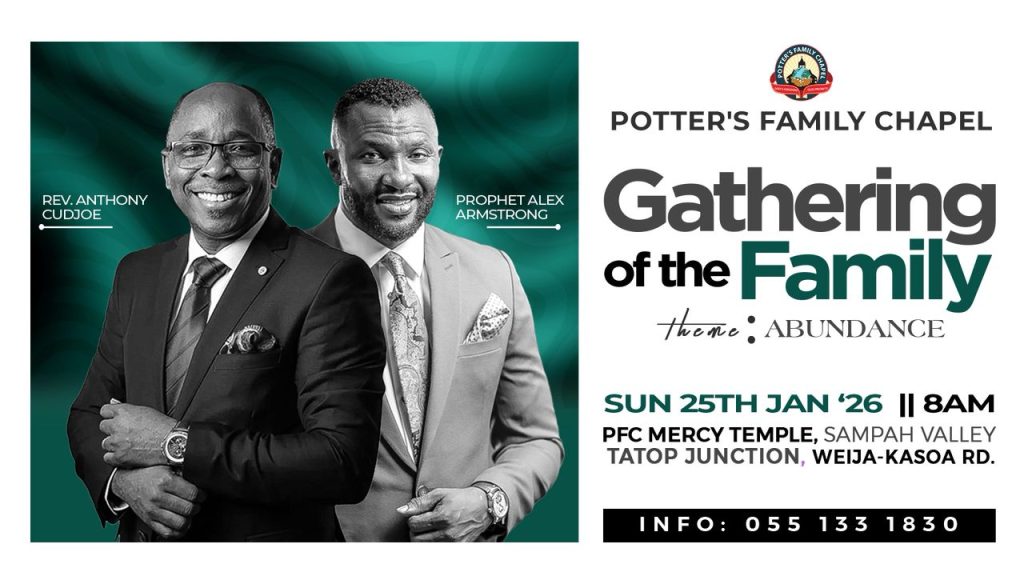
    On Sunday, January 25, 2026, the atmosphere at the Sampah Valley was charged with a palpable sense of expectation.  Potter’s Family Chapel held its landmark event, the Gathering of the Family, bringing together a community eager to step into a new spiritual chapter. Under the overarching theme of Abundance, the service served as both a spiritual refueling and a formal commissioning for the journey ahead.

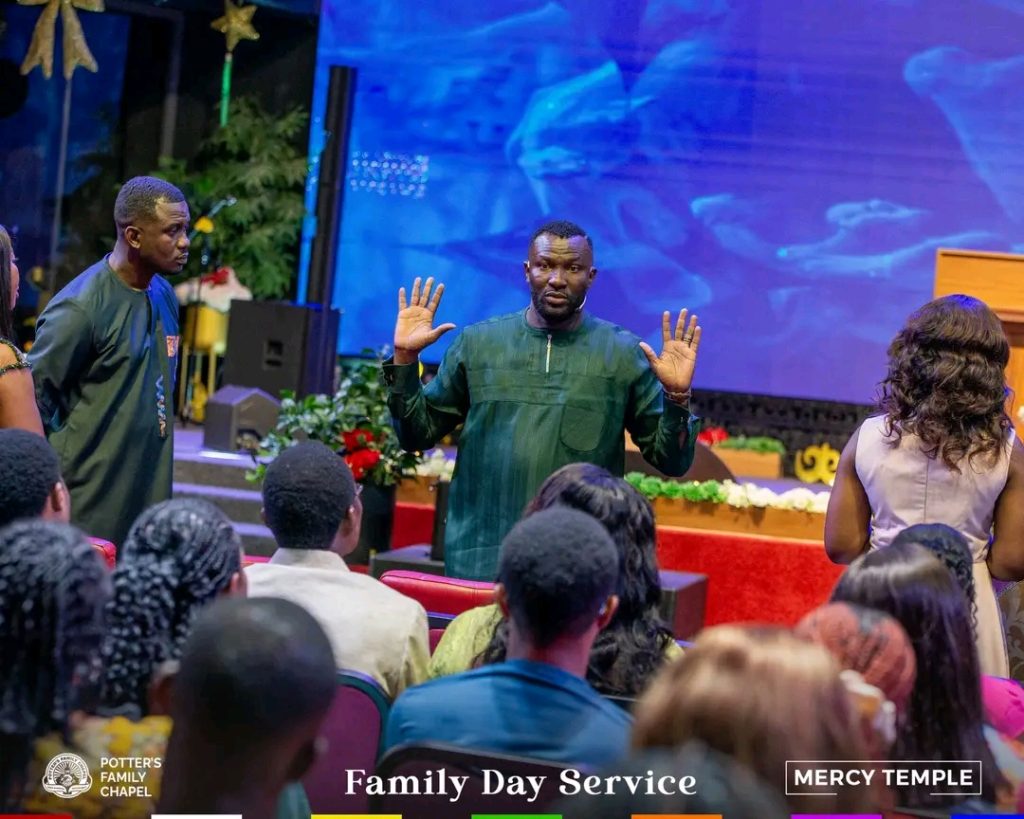
    ​The morning commenced with a deeply personal and spiritual encounter. Prophet Alex Armstrong began the service with the laying of hands, moving through the congregation in a focused demonstration of faith. This was immediately followed by a powerful declaration of blessings, where words of prosperity and divine favor were spoken over the lives of every individual present at the Mercy Temple.

    ​As the spiritual foundation was laid, the tempo shifted into a vibrant celebration of faith. Minister Paolo took the stage to lead the congregation in an energetic session of praises and worship. The music filled the sanctuary at Tatop Junction, creating a unified voice of gratitude that resonated throughout the Weija—Kasoa corridor.

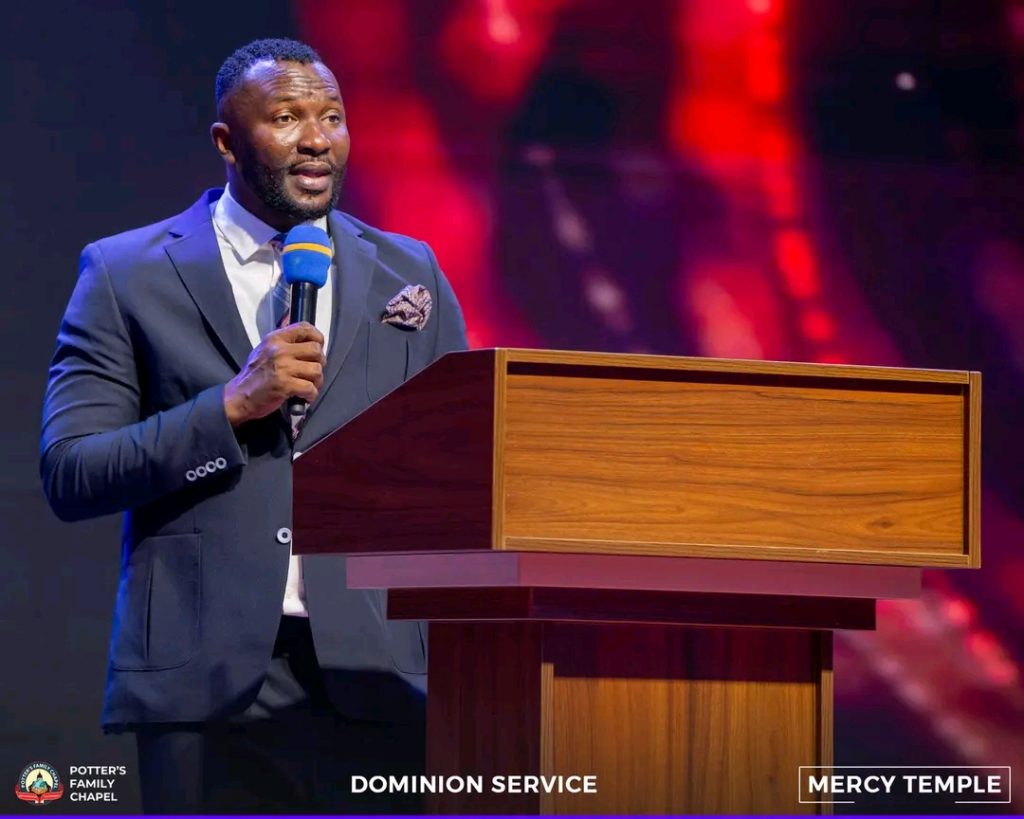
    ​With the congregation’s hearts prepared, Prophet Alex Armstrong returned to deliver the central sermon. His message focused on the prophetic theme of the year, Abundance. He spoke with conviction about the necessity of expanding one’s vision and preparing for the overflow that comes through dedicated service and trust.

    ​A highlight of the day was the formal induction of leaders and their assistants. In a solemn yet celebratory ceremony, these individuals were officially ushered into their offices. This induction marked a commitment to the growth of the chapel, ensuring that the vision of the ministry is carried forward by a dedicated and recognized leadership team.

    ​The event concluded with a final benediction, a closing prayer that sealed the declarations of the day. As the members of Potter’s Family Chapel departed the PFC Mercy Temple, there was a shared sense that the promise of abundance was no longer just a theme, but a lived reality for the days to come.

  • Is Christianity a Religion?

    Is Christianity a Religion?

    Oxford Languages define religion in these three ways:

    a. The belief in and worship of a superhuman power or powers, especially a God or gods.

    b. A particular system of faith and worship.
    plural noun: religions

    c. A pursuit or interest followed with great devotion.

    Christianity is, therefore, a religion and not merely one among many, but the only true religion.

    “And this is eternal life, that they know you, the only true God, and Jesus Christ whom you have sent.” (John 17:3)

    “And there is salvation in no one else, for there is no other name under heaven given among men by which we must be saved.” (Acts 4:12)

    It is the only true way to believe in and worship the true God. It is the only true system of faith and worship, revealed by God Himself, and it therefore calls for deep conviction and wholehearted devotion.

    “But the hour is coming, and is now here, when the true worshipers will worship the Father in spirit and truth.” (John 4:23–24)

    “For I did not receive it from any man, nor was I taught it, but I received it through a revelation of Jesus Christ.” (Galatians 1:11–12)

    “Present your bodies as a living sacrifice, holy and acceptable to God, which is your spiritual worship.” (Romans 12:1)

    For this reason, the term religion should not be demonised.

    The negative connotation often attached to the word, where religion is reduced to empty rituals, external performances, and moral pretence, is a later development. This meaning emerged largely from anti-religious sentiment that sought to portray religious people as hypocritical or inauthentic. Even a brief look at standard dictionaries shows that this definition typically appears after the more foundational meanings of religion as an organized system of belief and worship.

    Wiktionary puts this as the fourth definition for religion after calling it a belief in the metaphysial and a system of faith: “Rituals and actions associated with religious beliefs, but considered apart from them.”

    Now, even this fourth definition refers to rituals related to RELIGIOUS beliefs. The only difference is that, in this case, the rituals are the focus and not the beliefs. Christian examples would include baptism, communion, and fellowship. Considering them separately from the beliefs they’re associated with does not amount to an evil thing per se. However, this use of “religion” is often to highlight a disconnect between true religion and mere appearance or pretense.

    An example Wiktionary gives is,
    “I think some Christians would love Jesus more if they weren’t so stuck in religion.”

    Remember, I said this meaning evolved from an anti-religious sentiment on how religious people can be hypocritical?

    The Bible verse below reflects that definition or use of the term “religion”:

    “This people honors me with their lips, but their heart is far from me; in vain do they worship me.” (Matthew 15:8–9)

    But we are also taught by the Bible about pure and undefiled religion.

    “Religion that is pure and undefiled before God the Father is this…” (James 1:27)

    Thus, even if religion is defined as faith-based rituals or actions, the Bible commands us to engage in pure and undefiled religion. We are not completely free from biblical rituals and actions. We cannot claim to be Christians and hate “pure and undefiled” religion, which constitutes biblically sanctioned rituals and actions. Thus, we are expected to be religious and practice religion. You cannot be a Christian and not be religious. Pure and undefiled religion is practiced “before [in the sight of] God the Father”. How is it that people claim they can have a relationship with the Father and not have religion or be religious? Let’s not deceive ourselves! Call them to repentance and full commitment. Don’t give fake assurances.

    The distinction is that Christians are not “fake people” or not supposed to be. We should not engage in religious activities or good works hypocritically, but be transformed inside-out.0 Indeed, Christianity is not a man-made attempt to reach God through rituals and actions. True Christianity is not merely about church practices and good works, but it includes or commands specific actions.

    “For by grace you have been saved through faith… not a result of works.” (Ephesians 2:8–9)

    Also, Christianity is a relationship with God grounded in a divinely revealed system of faith. People say, “it is not a religion but a relationship”, as though the two were mutually exclusive. Every relationship with the supernatural or metaphysical must be based on some beliefs about their existence, nature, and how to relate with them. Thus, our relationship with the Father, in Christianity, is a religion. It is based on definite revealed knowledge about God’s nature and how He wants to be worshipped. Those system of beliefs make the faith a religion. And because they are true and effective, we enter into a real relationship with the real God.

    “Contend for the faith that was once for all delivered to the saints.” (Jude 1:3)

    This union of relationship and revealed structure makes Christianity a religion in the major and more popularly applied sense of the word.

    The unique truthfulness of Christianity can be communicated clearly without denying its religious character. In ordinary language (eg. when we fill forms), Christianity is rightly classified as a religion, and believers are not called to engage in unnecessary redefinitions of common terms. Faithful communication requires using generally accepted language to communicate true ideas in a way that people can understand, not abandoning it altogether.

    “If with your tongue you utter speech that is not intelligible, how will anyone know what is said?” (1 Corinthians 14:9)

    What must always be clarified is that Christianity is NOT an empty religion, especially if religion is defined as mere human effort and external observance attempts rather than actuals.

    “These have indeed an appearance of wisdom… but they are of no value in stopping the indulgence of the flesh.” (Colossians 2:20–23)

    However, Christianity is a religion in the major sense of the word: an organized, coherent system of faith. Unless this distinction is made clear, debates over the term become whining and often devolve into semantic games, an exercise that ultimately weakens, rather than strengthens, Christian communication.

    “Have nothing to do with foolish, ignorant controversies; you know that they breed quarrels.” (2 Timothy 2:14)

    “Remind them of these things and charge them before God not to quarrel about words, which does no good, but only ruins the hearers.”
    (2 Timothy 2:14)

    “If anyone teaches a different doctrine and does not agree with the sound words of our Lord Jesus Christ… he has an unhealthy craving for controversy and for quarrels about words.”
    (1 Timothy 6:3–4)

    This issue ties into what was discussed few days ago about how preachers sometimes use grammar to complicate simple ideas, solve the complication, and assume they have preached a revelation. We must stop engaging in such games because they are encumberances that prevent preachers from preaching the truth and doing it with good clarity. We must not have “unhealthy craving for controversy and for quarrel over words.” Scripture warns us clearly.

    “And I, when I came to you, did not come proclaiming to you the testimony of God with lofty speech or wisdom.” (1 Corinthians 2:1)

    “We have renounced disgraceful, underhanded ways… by the open statement of the truth.” (2 Corinthians 4:2)

    Shalom!


    By Yaa Ayeh

  • 10 Smartest Commandments Every Young Minister Must Obey for Sustainable Success.

    10 Smartest Commandments Every Young Minister Must Obey for Sustainable Success.

    The world upgraded, but you stayed analog, not because growth wasn’t available, but because you postponed obedience. Time never waits for your intention. Disobedience is costly. So obey today..

    1. Get educated in any field – don’t ignore this.
    Spiritual depth does not cancel intellectual responsibility. Education will give you structure to your thinking, credibility before men, and options for life beyond the pulpit.

    2. Belong to a church you truly call home, and be faithful there.
    Floating ministries don’t last. God plants people before He promotes them when you are faithful you attract authority and covering.

    3. Have both a spiritual father and a mentor.
    A spiritual father covers your life; a mentor sharpens your skill. One guards your soul, the other your growth. You need both. You can have all in one but know the difference

    4. Define your relationship with the opposite sex clearly.
    Ambiguity destroys ministries. Set boundaries early. Protect your calling before it needs rescuing. Be clear on this matter

    5. Do not fornicate or Thou Shall Not
    Grace forgives, but consequences remain. Sexual purity preserves your clarity, authority, and longevity in ministry.

    6. Master discipline before you pursue anointing.
    Anointing opens doors; discipline keeps you there. Prayer, punctuality, preparation, and consistency are non-negotiable.

    7. Develop financial intelligence and wisdom.
    Poverty is not a proof of humility. Learn budgeting, saving, giving, and investing. Ministry shouldn’t make you financially foolish.

    8. Serve faithfully before seeking a platform.
    Public elevation is sustained by private service. Those who skip service often crash with time.

    9. Build character louder than you build your gifts.
    Gifts announce you, but character keeps you trusted. Integrity will take you further than talent ever can. Ask around….

    10. Be patient with process and timing.
    Rushing ahead of God creates unnecessary pain. Growth is progressive. Stay aligned, stay teachable, and stay humble.

  • Stepping Into Abundance

    Stepping Into Abundance

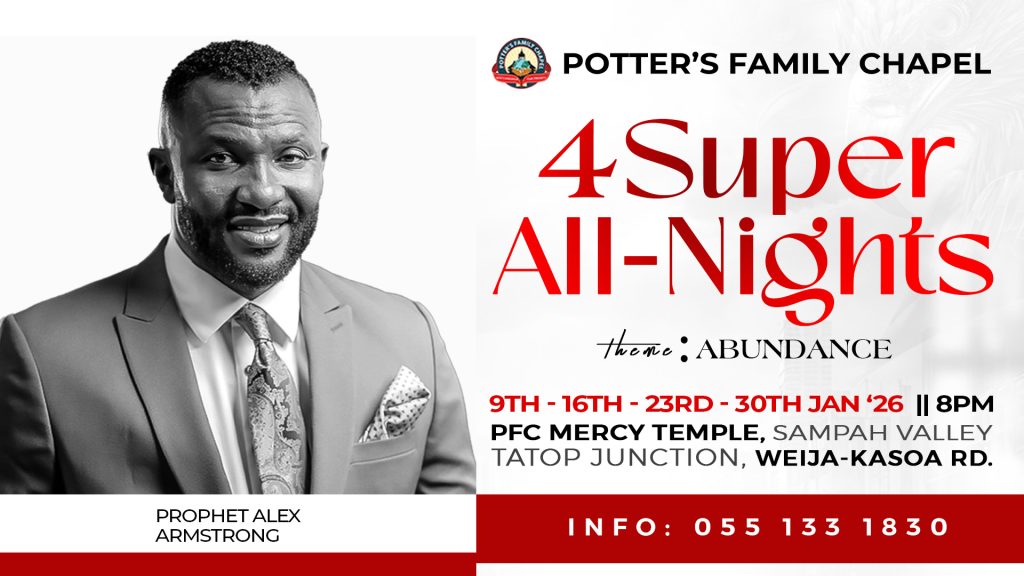
    As a new year unfolds, Potter’s Family Chapel is setting aside four powerful nights to seek God with focus, hunger, and expectation. 4 Super All-Nights is more than a program on the calendar.  it is a deliberate spiritual journey designed to realign hearts, renew minds, and unlock what God has already prepared for His people.
    Taking place on January 9th, 16th, 23rd, and 30th, 2026, these all-night gatherings begin at 8:00 PM each Friday at PFC Mercy Temple, located at Sampah Valley, Tatop Junction, Weija-Kasoa Road. The theme for the month, Abundance, speaks directly to a deep longing many carry into a new year. The desire for a life that is full, purposeful, and sustained by God’s grace.
    Abundance, in this context, goes beyond material increase. It is about wholeness, abundance of peace, clarity, strength, wisdom, favor, and spiritual depth. In a world marked by pressure, uncertainty, and limitation, these nights are created to help believers step out of survival mode and into alignment with God’s promises. They are moments to pause, reflect, repent where needed, and receive fresh direction for the season ahead.

    The services will be ministered by Prophet Alex Armstrong, whose ministry carries a strong emphasis on faith, obedience, and practical Christian living. Through teaching, prayer, and prophetic insight, participants will be guided to confront mindsets that restrict growth and to embrace truths that lead to lasting transformation. These nights are designed to stretch faith, awaken spiritual sensitivity, and restore confidence in God’s ability to do exceedingly more.

    Night gatherings have always held a special place in scripture.  Moments when distractions are few, hearts are open, and divine encounters are more likely to take place. 4 Super All-Nights builds on this biblical pattern, creating an atmosphere where individuals, families, and the church community can seek God without hurry or restraint. It is a space to cry out, listen deeply, and receive instruction for the journey ahead.

    As 2026 begins, this program serves as a spiritual foundation for the year. It invites all who are weary, hopeful, curious, or expectant to come as they are and leave renewed. Whether you are trusting God for restoration, breakthrough, direction, or a deeper walk with Him, these nights offer an opportunity to reset your spiritual compass and move forward with clarity and faith.

    Attendance is open to all, and everyone is welcome. Come prepared to stay, to pray, and to encounter God in a fresh way.

  • The Year of Abundance: Rooted, Receptive, and Overflowing

    The Year of Abundance: Rooted, Receptive, and Overflowing

    We stand at the threshold of a new season, declared in our hearts and upon our walls: 2026: The Year of Abundance. This is not merely a theme, but a prophetic posture. An invitation from the Divine Potter to shift our perspective from scarcity to supernatural provision, from lack to the overwhelming fullness of God’s grace.

    True abundance, as Scripture teaches, begins not in our hands, but in our souls. It is the deep, settled peace that comes from knowing our Shepherd. As David proclaimed, “The Lord is my shepherd; I shall not want” (Psalm 23:1). Our “not wanting” is the first fruit of spiritual abundance. A heart so satisfied in His presence that the anxieties of this world lose their power. This year, we are called to dwell first in that green pasture, beside those still waters, allowing Him to restore our souls.

    From that place of restoration, we understand that God’s abundance is multifaceted. It is an abundance of mercy for our past (Lamentations 3:22-23), strength for our present (Philippians 4:13), and hope for our future (Jeremiah 29:11). It is the abundance seen in the widow’s jar of oil that did not run dry (2 Kings 4:1-7), and in the disciples’ nets, straining under the weight of a catch they could not contain (Luke 5:1-11). These were miracles born not of human striving, but of divine invitation and obedient response.

    The cornerstone of our journey this year is found in Christ’s own words: “I came that they may have life and have it abundantly” (John 10:10). This is the heartbeat of our Year of Abundance. A life infused with the quality of eternity, rich in love, joy, purpose, and spiritual vitality. It is an abundance meant to be shared, to become a river flowing out from within us (John 7:38).

    This year, let every prayer, every act of service be infused with the faith that we are known, led, and provided for by a God whose nature is to overflow. Let us be a community marked by shared abundance where no one walks in lack, where every heart is full, and where every testimony points back to the goodness of our Father.

    We are not waiting for abundance. We are living in it, from it, and for it. Welcome to the Year of Abundance. May our cups, our hearts, and our lives overflow.


  • These Five Things Will Save Your Ministry

    These Five Things Will Save Your Ministry

    1. DON’T LET MINISTRY BECOME YOUR IDENTITY

    Most pastors unconsciously tie their worth to the pulpit, attendance, or how powerful a service felt. But when your identity is swallowed by ministry, failure, low numbers, or dry seasons feel like personal death.

    Anchor your identity in Christ first (as a child of God, not as “Pastor.” This keeps you grounded when ministry seasons shift.

    2. LEARN TO REST WITHOUT FEELING GUILTY

    Rest is not laziness; it is warfare against burnout. Many ministers think taking a day off is weakness, but Jesus Himself withdrew often.

    If you don’t schedule rest, your body will force it through sickness, exhaustion, or emotional breakdown. Rest is stewardship of the vessel God uses.

    3. YOUR PRIVATE OBEDIENCE PREACHES LOUDER THAN YOUR SERMONS

    People may forget your three-point sermon, but they will never forget how they feel around your character.

    What you refuse to compromise on in private (money, sexual purity, honesty) builds an unseen authority that no stage performance can give you.

    Guard the “backstage life” as much as you prepare the “stage life.”

    4. DON’T CONFUSE MOMENTUM WITH GROWTH

    A crowd is not always evidence of deep growth. Sometimes noise, novelty, or hype fills the room (but real growth shows in transformed lives, not packed chairs.

    Ask yourself: are people becoming disciples, or just event attendees?

    Momentum attracts men, but growth sustains them.

    5. PREPARE FOR SUCCESSION EARLY

    Many ministers wait until they are weak, old, or dying before thinking of who will continue the work. This often kills churches after the founder.

    Start investing in the next generation now: mentor, empower, and release. The ministry is bigger than you, and the legacy should not die with your voice.


    By Yaa Ayeh


  • The Unseen Weight Pastors Carry Because Of Unspoken Member Expectations.

    The Unseen Weight Pastors Carry Because Of Unspoken Member Expectations.

    There is a silent weight that rests on the shoulders of every true pastor ( not because of what people demand openly, but because of what they expect silently.

    Many members never speak it, but they carry invisible checklists in their hearts:
    That the pastor must always be strong.
    That the pastor must never have a bad day.
    That the pastor must pray, hear, discern, visit, provide, and yet never feel tired.
    That he must read their minds and meet their needs ( sometimes needs they never even voice.

    These unspoken expectations form a spiritual pressure that heaven alone can measure.
    While people see the pulpit on Sunday, heaven sees the burden on Monday.
    Pastors are often crushed between divine assignment and human assumption.

    Some members get offended not because the pastor failed spiritually, but because he failed to meet an expectation he never knew existed.
    You’ll hear it whispered:
    “He didn’t call me.”
    “He didn’t notice my pain.”
    “He didn’t attend my event.”
    Yet nobody told him. They expected him to discern it.

    What people forget is that discernment is a gift of the Spirit, not a replacement for communication.
    Even prophets are human.
    Even shepherds bleed.

    Every true pastor carries not just sermons (but souls.
    Every face in the pew is a weight on the altar.
    When members complain, the pastor prays.
    When they withdraw, he worries.
    When they leave, he questions himself before God.
    He often carries guilt that heaven never gave him.

    That’s why many great men of God preach with passion but sleep with tears.
    They smile in daylight but wrestle in the night with questions no one will ever hear:
    “Did I fail them?”
    “Did I miss God?”
    “Did I give enough?”

    DEAR MEMBER, sometimes the most spiritual thing you can do is to pray for your pastor.
    Not because he is weak, but because he is human.
    He stands in battle for many who never stand in prayer for him.

    If you knew the weight of what your pastor carries silently,
    you would stop judging his tone and start interceding for his heart

    REMEMBER THAT
    The oil you enjoy on Sunday often flows from the tears your pastor shed in secret.
    The sermon you celebrate may have been born in a night of warfare you never saw.


    By Yaa Ayeh